VapoFil Official Website › Journal › Saw Palmetto Extract
The One Saw Palmetto Extract That Worked, And This Panel's Row Does Not Name It
Pool every saw palmetto trial together and the ingredient looks like it does nothing. Isolate the one branded, chemically defined extract with a stated fatty-acid profile, and a modest benefit appears. That split is the whole story of saw palmetto research, and it turns on something a label either states or does not: the extraction method. VapoFil's row states none of it. Here is what separates the extract that showed a result from the ones that did not, and where a 20 mg row with no stated ratio falls between them.
What the VapoFil panel prints for this row
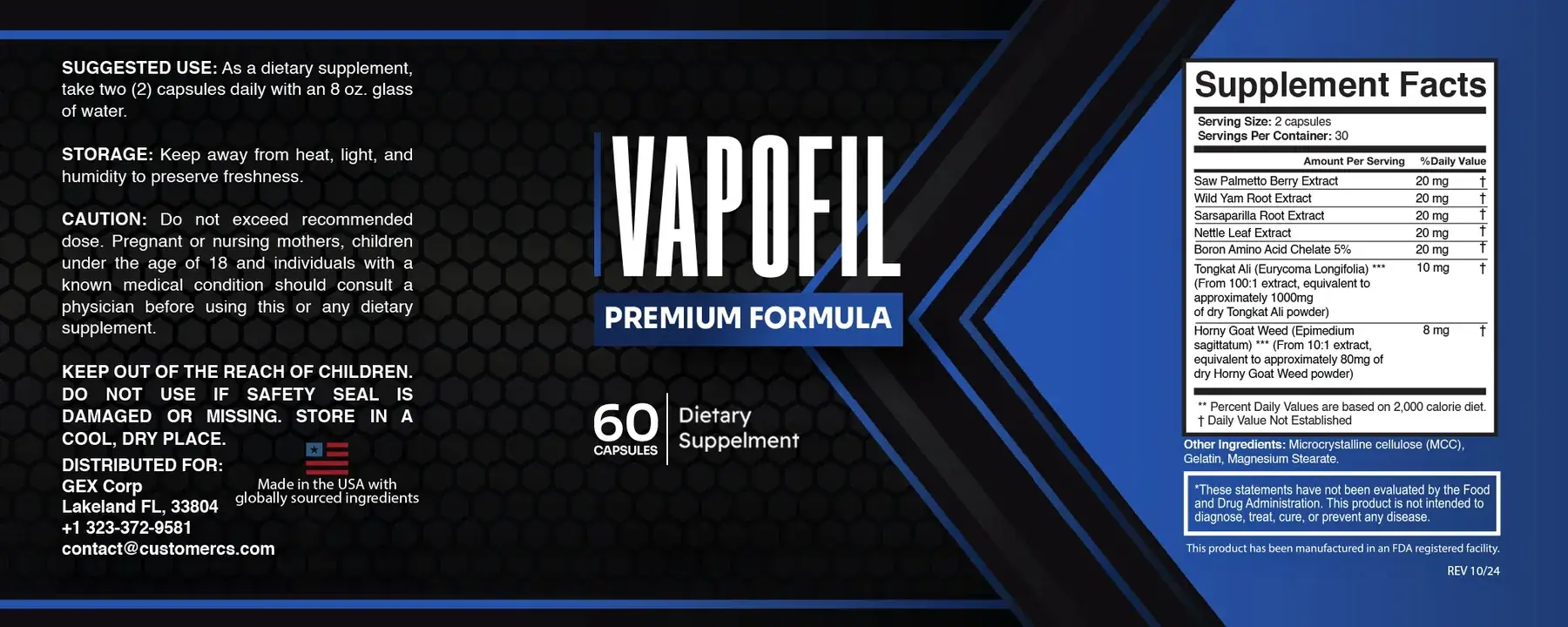
The supplement facts page lists Saw Palmetto Berry Extract, Serenoa repens, at 20 mg per two-capsule serving. No ratio is printed beside it and no percentage of any named compound is declared, so the row reads as a plain berry extract rather than a standardised one. That is worth holding in mind for everything below, because almost every trial discussed on this page used a specific, defined preparation rather than an undefined one.
Saw palmetto sits on VapoFil's panel as part of the vitality formula, alongside tongkat ali and horny goat weed. But its own research history was not built around libido or sexual function at all. It was built around the prostate, and specifically around benign prostatic hyperplasia (BPH) — the non-cancerous enlargement of the prostate that produces urinary symptoms as men age. That distinction runs through every study below.
The largest trial ever run, and what it measured
The best-known saw palmetto trial is the CAMUS study (Complementary and Alternative Medicine for Urological Symptoms), published in JAMA in 2011. It randomised 369 men aged 45 and over to placebo or saw palmetto extract, starting at the standard dose of 320 mg a day and escalating to double and then triple that dose — 640 mg, then 960 mg — over 72 weeks.
The outcome measured was the American Urological Association Symptom Index, a validated questionnaire for urinary symptoms: how often a man wakes at night to urinate, how strong the stream is, how often urination feels incomplete. It is not a measure of desire, stamina or sexual confidence. Over 72 weeks, symptom scores improved in both groups — and slightly more in the placebo group. Saw palmetto, at up to 960 mg a day, was not more effective than placebo for the primary outcome or for any secondary outcome measured, including sexual function scores collected as a secondary endpoint.
| Detail | CAMUS trial (Barry 2011) | VapoFil panel |
|---|---|---|
| Dose tested | 320 mg, rising to 960 mg/day | 20 mg/day |
| Duration | 72 weeks | Not applicable |
| What was measured | Urinary symptom score (AUASI) | Not measured on this label |
| Result vs placebo | No significant difference | Not applicable |
Forty-eight times the amount on this panel, tested for a year and a half, on a symptom this panel does not claim to treat — and it still did not beat placebo.
The 2023 Cochrane verdict, in plain terms
CAMUS was not an outlier. The Cochrane Collaboration keeps the most conservative, most frequently updated systematic review in medicine, and its saw palmetto review was refreshed again in June 2023, the fourth update since the review began. It searched every major database for randomised trials of Serenoa repens monotherapy against placebo for BPH-related urinary symptoms, at any dose.
The 2012 update, folding in 17 trials and 2,008 men, found no meaningful difference from placebo on symptom scores or peak urinary flow. The 2023 update, with more trials and more years of follow-up behind it, reached the same place: saw palmetto extract, taken broadly across the trials pooled, does not outperform placebo for BPH symptoms. That is not a fringe conclusion or an isolated negative study. It is the standing verdict of the review process medicine trusts most for exactly this question, reaffirmed as recently as three years ago.
None of those trials measured libido or sexual desire as a primary outcome, because none of them were designed to. The question they were built to answer was urinary, and the answer to that question, at doses fifteen to forty-eight times higher than VapoFil's, was largely negative.
The one extract that beat placebo, and why it was the only one
This is the part of the record that a pooled dose comparison alone does not show. A 2016 systematic review and meta-analysis in European Urology Focus looked specifically at Permixon, a single branded hexanic (hexane-solvent) lipidosterolic extract of saw palmetto with a defined, reproducible fatty-acid profile. Pooling 12 randomised trials of that one specific preparation, the reviewers found Permixon modestly outperformed placebo on two measures — fewer night-time trips to the bathroom and a faster peak urine flow — while overall symptom scores and adverse-event rates were similar to placebo. Nothing else in the saw palmetto literature, pooled at any dose, cleared that bar.
The authors were explicit about why they isolated one product: earlier pooled reviews mixed together saw palmetto extracts made by different solvents and processes, which are not chemically identical products even when the label says the same plant. Permixon's own trial record looks somewhat better than the pooled literature precisely because it is a single, consistently manufactured extract rather than a category of loosely related preparations sharing a common name. Take that one defined preparation out of the pool, and the CAMUS and Cochrane results above are what remains: no measurable benefit for an undifferentiated "saw palmetto" row.
VapoFil's row does not name an extraction method, a solvent, a fatty-acid percentage or a brand reference. There is no way to know whether the 20 mg here shares more in common with Permixon's defined profile or with one of the less consistent preparations the broader reviews found wanting. The label does not say, and nothing on this website is positioned to say for it. That is the actual reason this row cannot borrow the one positive result in the literature, and it holds regardless of dose.
Seven actives, every printed amount on one page
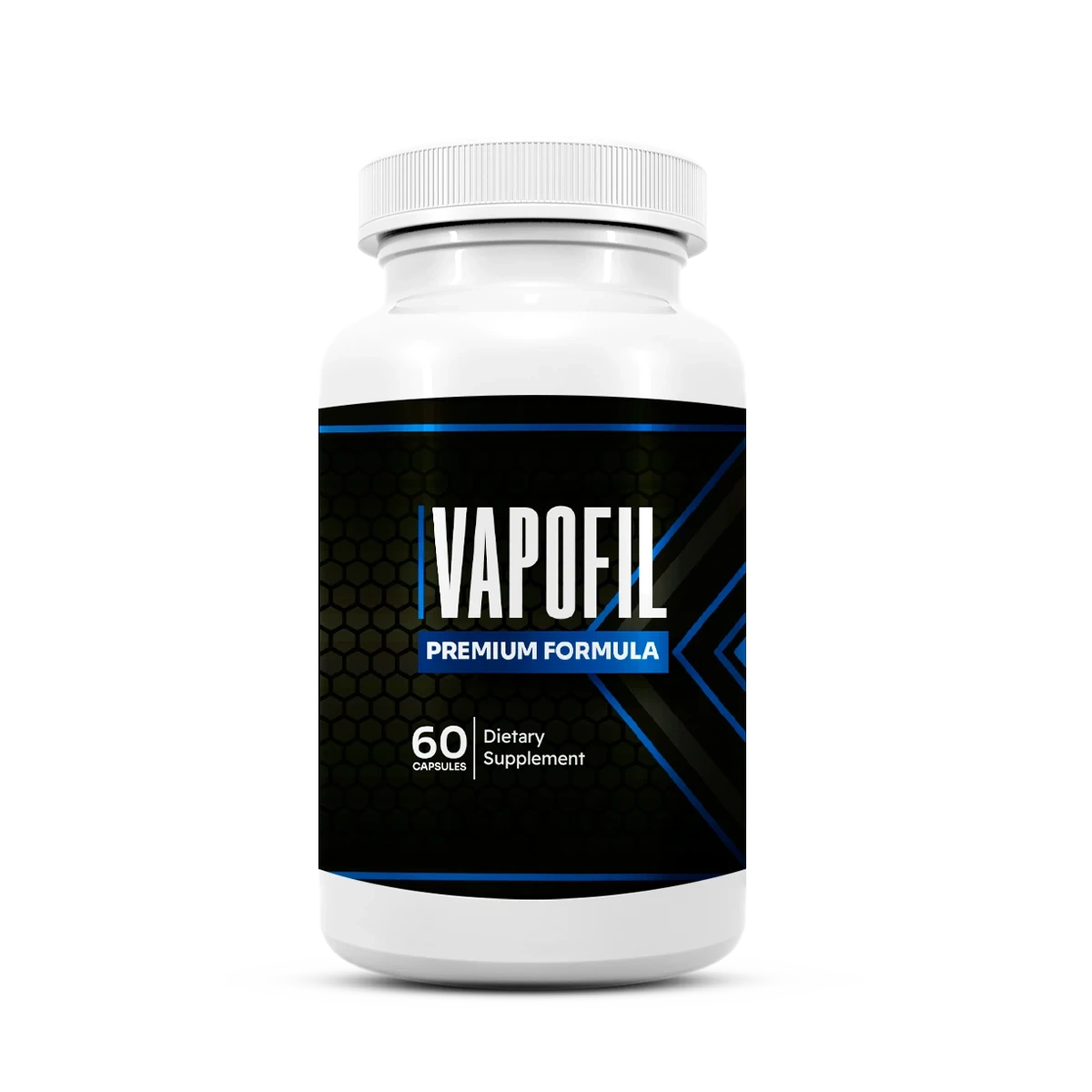
Two capsules a day, 60 capsules to a bottle, and every ingredient's amount set beside what its own research used.
One bottle $89 · six bottles $294 · 60-day money-back guarantee
Order VapoFilThe mechanism story: what it shows and what it does not
There is a genuine, well-documented mechanism behind saw palmetto, and it is worth stating plainly because it explains why the ingredient keeps appearing on labels like this one. A 2005 laboratory study in the International Journal of Cancer found that Permixon inhibits 5-alpha-reductase — the enzyme that converts testosterone into dihydrotestosterone (DHT) — in human prostate cancer cell lines, without suppressing the cell's ability to produce prostate-specific antigen (PSA). That is a real finding, and it is why saw palmetto is sometimes described as acting like a mild, natural version of prescription 5-alpha-reductase inhibitors.
What that study does not show is a human dose-response relationship, an effect on libido, or an effect at 20 mg of an unstandardised extract. It is a cell-line experiment: prostate cancer cells in a dish, exposed to a specific branded extract at laboratory concentrations chosen by the researchers, not a capsule taken by a man. Cell-line inhibition of an enzyme is evidence of a plausible mechanism. It is not evidence that a 20 mg capsule changes DHT levels in a living person, let alone that doing so would change libido rather than urinary flow. The CAMUS and Cochrane results above are what happened when that mechanism was actually tested in men, at far higher doses, and it did not translate into a measurable symptom benefit.
Safety, at doses far above this panel's
The safety picture is more reassuring than the efficacy picture, which is one honest thing to say for this ingredient. A detailed 2008 safety assessment in Complementary Therapies in Medicine, run alongside the same research group's earlier trial work, followed men taking saw palmetto extract and reported no clinically meaningful pattern of adverse events distinct from placebo, with mild digestive upset the most common complaint at any dose. CAMUS itself, at up to 960 mg a day for 72 weeks, found no clearly attributable adverse effects and confirmed that saw palmetto did not interfere with PSA readings — useful reassurance for anyone whose doctor uses that test.
None of this changes the efficacy picture above. A supplement can be well tolerated and still not do what a label implies. Saw palmetto's safety record at doses far higher than VapoFil's is a reasonable basis for taking 20 mg without particular concern; it is not evidence that 20 mg does anything measurable.
Which side of the split this 20 mg row falls on
Put the pieces together and the honest summary is this. Saw palmetto research splits cleanly into two piles: pooled, mixed-preparation trials (CAMUS included) that show no benefit over placebo, and one meta-analysis of a single defined, branded extract that shows a modest one. The dividing line between those piles is not dose alone; it is whether the product tested was a chemically specified preparation or an undifferentiated "saw palmetto extract." VapoFil's row is the second kind. It names an amount — 20 mg — and nothing else: no ratio, no percentage, no solvent, no fatty-acid profile, no brand reference.
That absence matters independently of the dose gap. Even if VapoFil's 20 mg were scaled up to the 320 mg CAMUS dose, there would still be no way to know which pile it belongs in, because the label does not specify the one variable the 2016 meta-analysis identified as the difference between a result and no result. A vitality label that also does not measure or claim libido as an outcome in its own research history adds a second, separate reason this row cannot borrow saw palmetto's positive result: that result was for urinary symptoms in men with BPH, not for stamina or desire, at any dose.
A companion piece on this panel's ratios covers what a stated 100:1 ratio does and does not tell you, and this domain's look at the four rows with no ratio at all extends this same question to wild yam, sarsaparilla and nettle leaf, which share saw palmetto's undefined-extract problem.
- Pooled saw palmetto trials (CAMUS 2011, the 2023 Cochrane review) show no benefit over placebo for urinary symptoms.
- One 2016 meta-analysis found a modest benefit — but only for Permixon, a single chemically defined branded extract.
- The difference between those two results is the extraction method, not the dose alone.
- VapoFil's row states an amount but no ratio, percentage or extraction method, so it cannot be matched to the one extract that worked.
- The mechanism evidence (5-alpha-reductase inhibition) comes from a cell-line study, not a human trial.
- None of the trials discussed measured libido; the research history is about urinary symptoms in BPH.
Bottom line
Saw palmetto has exactly one positive clinical result in its literature, and it belongs to a single named, chemically defined extract — not to "saw palmetto" as an ingredient category. VapoFil's row states 20 mg and nothing about how that 20 mg was made, which means it cannot claim that one result any more than it can claim the negative pooled results apply less to it. That does not make the ingredient a mistake to include; the traditional and mechanistic case for it is real, and the safety record is clean at doses far above this one. It does mean the row's presence on the label is closer to a nod to the category's history than a citation of evidence for what the label implies it does.
References
- Barry MJ, Meleth S, Lee JY, et al; CAMUS Study Group. Effect of increasing doses of saw palmetto extract on lower urinary tract symptoms: a randomized trial. JAMA. 2011;306(12):1344-1351. PMID 21954478. https://pubmed.ncbi.nlm.nih.gov/21954478/
- Franco JV, Trivisonno L, Sgarbossa NJ, Alvez GA, Fieiras C, Escobar Liquitay CM, Jung JH. Serenoa repens for the treatment of lower urinary tract symptoms due to benign prostatic enlargement. Cochrane Database Syst Rev. 2023;6(6):CD001423. PMID 37345871. https://pubmed.ncbi.nlm.nih.gov/37345871/
- Novara G, Giannarini G, Alcaraz A, Cózar-Olmo JM, Descazeaud A, Montorsi F, Ficarra V. Efficacy and Safety of Hexanic Lipidosterolic Extract of Serenoa repens (Permixon) in the Treatment of Lower Urinary Tract Symptoms Due to Benign Prostatic Hyperplasia: Systematic Review and Meta-analysis of Randomized Controlled Trials. Eur Urol Focus. 2016;2(5):553-561. PMID 28723522. https://pubmed.ncbi.nlm.nih.gov/28723522/
- Habib FK, Ross M, Ho CK, Lyons V, Chapman K. Serenoa repens (Permixon) inhibits the 5alpha-reductase activity of human prostate cancer cell lines without interfering with PSA expression. Int J Cancer. 2005;114(2):190-194. PMID 15543614. https://pubmed.ncbi.nlm.nih.gov/15543614/
- Avins AL, Bent S, Staccone S, Badua E, Padula A, Goldberg H, Neuhaus J, Hudes E, Shinohara K, Kane C. A detailed safety assessment of a saw palmetto extract. Complement Ther Med. 2008;16(3):147-154. PMID 18534327. https://pubmed.ncbi.nlm.nih.gov/18534327/