VapoFil Official Website › Choosing A Formula
Choosing A FormulaHow To Choose A Men’s Vitality Formula: Eight Questions, In Order
Eight questions, arranged so the ones that eliminate the most products come first. Question one removes more bottles from consideration than the other seven combined. None of them requires any knowledge of chemistry, and all eight can be answered from a product page in about five minutes.
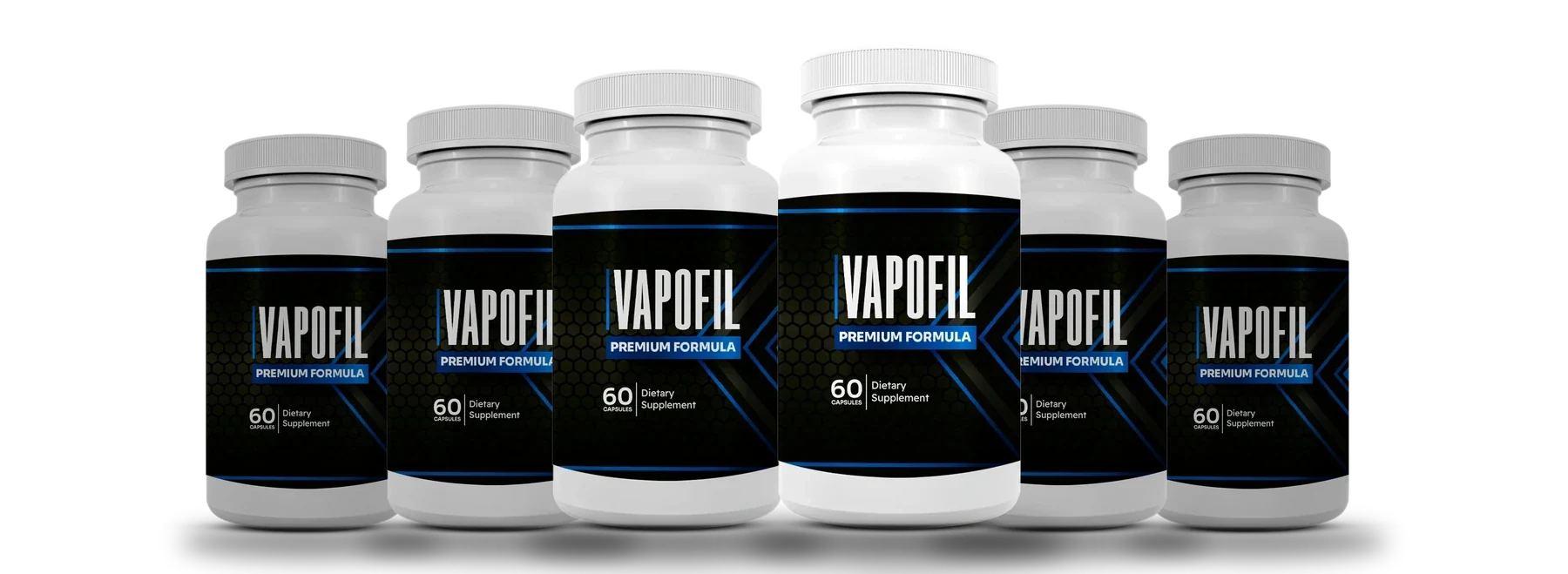
The method is applied to this website's own product at the foot, with the answers printed, including the ones that are not flattering.
Question 1: does the label print an amount for every ingredient?
This is the question that does most of the work, and it is worth asking before anything else because a no makes the remaining seven unanswerable.
A proprietary blend tells you the combined weight of several ingredients and nothing about the split. A blend listing eight plants at 900 mg total could be 880 mg of the cheapest one and a fifth of a gram divided between the other seven, and there is no way to tell from the outside. The order of the list is required to follow descending weight, which is the only information a blend gives you.
So: if amounts are printed, continue. If they are not, the product cannot be compared with any published trial and no amount of reading the rest of the page will change that. In this category roughly half the shelf fails here.
Some labels print amounts for two or three headline ingredients and bury the rest in a blend. That is worse than a plain blend, because it looks like disclosure. Check that every named active has a figure against it.
Question 2: how do those amounts compare with the published trials?
Now the figures can be used. Take the two or three ingredients the marketing leans on hardest and find what the trials used. For this category the reference points worth memorising are short: tongkat ali at 100 to 400 mg a day of a standardised extract, saw palmetto at 320 mg a day, nettle root at 459 mg a day.
A product an order of magnitude below those figures is not necessarily worthless, but it is unmeasured at the amount it actually contains, and a page claiming the trial's result for it is claiming something nobody has tested.
The honest scoring here is a spectrum rather than a pass or fail. Within 50% of a trial dose is comparable. Within a tenth is a different product wearing the same ingredient's name.
Question 3: is any ingredient printed as a ratio or a percentage?
If so, do the arithmetic before comparing anything. A 10:1 extract at 8 mg is 80 mg of dry herb equivalent. A chelate declared at 5% at 20 mg is 1 mg of the mineral.
Both conversions favour the reader when the label prints the ratio, because a label that prints only the compound weight has given you a number you cannot use. Credit a label for declaring a ratio and then discount what the ratio implies: it describes the input to a process, not the output, and two extracts at the same ratio can differ several-fold.
A standardisation — standardised to 2% eurycomanone, or a stated fatty acid percentage for saw palmetto — is the stronger disclosure and it is rare on a consumer label in this aisle.
Question 4: which plant part, and which species?
The cheapest way to appear to include an expensive ingredient is to include a different part of the same plant. Nettle root and nettle leaf is the standing example in this category, and it is not a technicality: the clinical review is about the root because the root is what was studied.
Species matters the same way. Sarsaparilla is a genus, and the review literature treats the species separately. A label naming only a common name has told you less than it appears to.
Ask two things of every botanical row: which part of the plant, and which species. A label that answers both is unusual and is telling you something about how it was written.
Question 5: what are the other ingredients, and do the pack marks agree with them?
The other-ingredients line is the least-read part of a supplement label and it settles more questions than the panel does. It names the capsule shell, which determines whether the product is suitable for a vegetarian or vegan diet, and it names the excipients.
It is also where pack marks go to die. A vegetarian roundel on a pack whose other-ingredients line reads gelatin is a contradiction, and the line wins because the line describes what is in the capsule. Checking the marks against that line takes ten seconds and catches a category of error that is more common than it should be.
The same scepticism applies to every other mark. A facility mark describes the factory's procedures. A sourcing mark describes raw material. Neither describes whether the formula works, and a mark with no named certifier is the seller's own assertion drawn in a circle.
Questions 6, 7 and 8: the commercial three
Question 6: is there a single-bottle option, and what does it cost?
A category that forces a ninety-day commitment on a first purchase is telling you something about its confidence. Where a single bottle exists, compare its per-day cost against the largest tier: a very large gap means the single bottle is priced as a sample rather than sold as a product.
Question 7: what exactly does the guarantee cover?
Length is the least informative term. The two that matter are whether opened bottles are included, and whether the clock starts at purchase or at delivery. A ninety-day window on unopened stock is a returns policy. A sixty-day window on opened bottles is a guarantee.
Question 8: does the page criticise its own product anywhere?
Not as a matter of taste. A page that has read the label it is selling will have found something awkward, because every label in this category has something awkward on it. A page with no criticism has not read it, which tells you how much checking went into the rest.
The eight questions applied to the product this website sells
| Question | The answer | Verdict |
|---|---|---|
| 1. Amounts printed? | All seven, with no proprietary blend. | Pass |
| 2. Against the trials? | Five of seven rows sit at 20 mg against trial amounts ten to thirty times larger. | Fail |
| 3. Ratios declared? | Both concentrates state a ratio and a dry-weight equivalent. Neither states a standardisation. | Partial pass |
| 4. Part and species? | Plant parts are named on every botanical row. The sarsaparilla species is not. | Partial pass |
| 5. Other ingredients and marks? | The line names gelatin. The pack carries a vegetarian roundel. | Fail |
| 6. Single bottle? | Yes, at $89 plus postage against $49 a bottle on six. | Pass, expensively |
| 7. Guarantee? | Sixty days, opened bottles included, clock from purchase. | Pass |
| 8. Criticism? | The dosage comparison and three label conflicts are printed. | Judge for yourself |
Four passes, two partials and two failures on this desk's own product. A method that cannot fail the thing it is applied to is not a method.
That table is the reason these two guides sit apart from the product pages. Applied honestly, the eight questions are not flattering to any bottle in this aisle, including this one, and a guide constructed so that its own product came out unblemished would be worth nothing to the person reading it.
Sources for this method
Ten sources, covering the reference amounts and the category's quality problem.
- Chinnappan SM, George A, Pandey P, et al. Effect of Eurycoma longifolia standardised aqueous root extract-Physta on testosterone levels and quality of life in ageing male subjects: a randomised, double-blind, placebo-controlled multicentre study. Food Nutr Res. 2021;65:5647. PMID 34262417. https://pubmed.ncbi.nlm.nih.gov/34262417/
- Franco JV, Trivisonno L, Sgarbossa NJ, et al. Serenoa repens for the treatment of lower urinary tract symptoms due to benign prostatic enlargement. Cochrane Database Syst Rev. 2023;6(6):CD001423. PMID 37345871. https://pubmed.ncbi.nlm.nih.gov/37345871/
- Schneider T, Rübben H. Stinging nettle root extract (Bazoton-uno) in long term treatment of benign prostatic syndrome (BPS). Results of a randomized, double-blind, placebo controlled multicenter study after 12 months. Urologe A. 2004;43(3):302-6. PMID 15045190. https://pubmed.ncbi.nlm.nih.gov/15045190/
- Chrubasik JE, Roufogalis BD, Wagner H, Chrubasik S. A comprehensive review on the stinging nettle effect and efficacy profiles. Part II: urticae radix. Phytomedicine. 2007;14(7-8):568-79. PMID 17509841. https://pubmed.ncbi.nlm.nih.gov/17509841/
- Hua S, Zhang Y, Liu J, et al. Ethnomedicine, Phytochemistry and Pharmacology of Smilax glabra: An Important Traditional Chinese Medicine. Am J Chin Med. 2018;46(2):261-297. PMID 29433390. https://pubmed.ncbi.nlm.nih.gov/29433390/
- Nielsen FH. Update on human health effects of boron. J Trace Elem Med Biol. 2014;28(4):383-7. PMID 25063690. https://pubmed.ncbi.nlm.nih.gov/25063690/
- Kee CL, Ge X, Low MY, et al. Analytical methods for the detection and characterization of unapproved phosphodiesterase type 5 inhibitors (PDE-5i) used in adulteration of dietary supplements - a review. Food Addit Contam Part A Chem Anal Control Expo Risk Assess. 2023;40(12):1495-1530. PMID 38011602. https://pubmed.ncbi.nlm.nih.gov/38011602/
- Using Dietary Supplements Wisely. National Center for Complementary and Integrative Health, National Institutes of Health. https://www.nccih.nih.gov/health/using-dietary-supplements-wisely
- Dietary Supplements: What You Need to Know. Office of Dietary Supplements, National Institutes of Health. https://ods.od.nih.gov/factsheets/WYNTK-Consumer/
- Questions and Answers on Dietary Supplements. U.S. Food and Drug Administration. https://www.fda.gov/food/information-consumers-using-dietary-supplements/questions-and-answers-dietary-supplements