VapoFil Official Website › Journal › The Hormone Question
Three Ingredients, Two Directions: The Hormone Question This Panel Does Not Answer
One ingredient on the VapoFil panel blocks a testosterone-converting enzyme in laboratory prostate cells. Two others raised free testosterone in small human trials. Nobody has ever tested what happens when all three sit in the same capsule, because nobody has tested this combination at all. Here is what each ingredient's own research actually found, and why that makes "speak to a doctor before use" more than boilerplate for some readers.
Three rows, three different hormonal stories
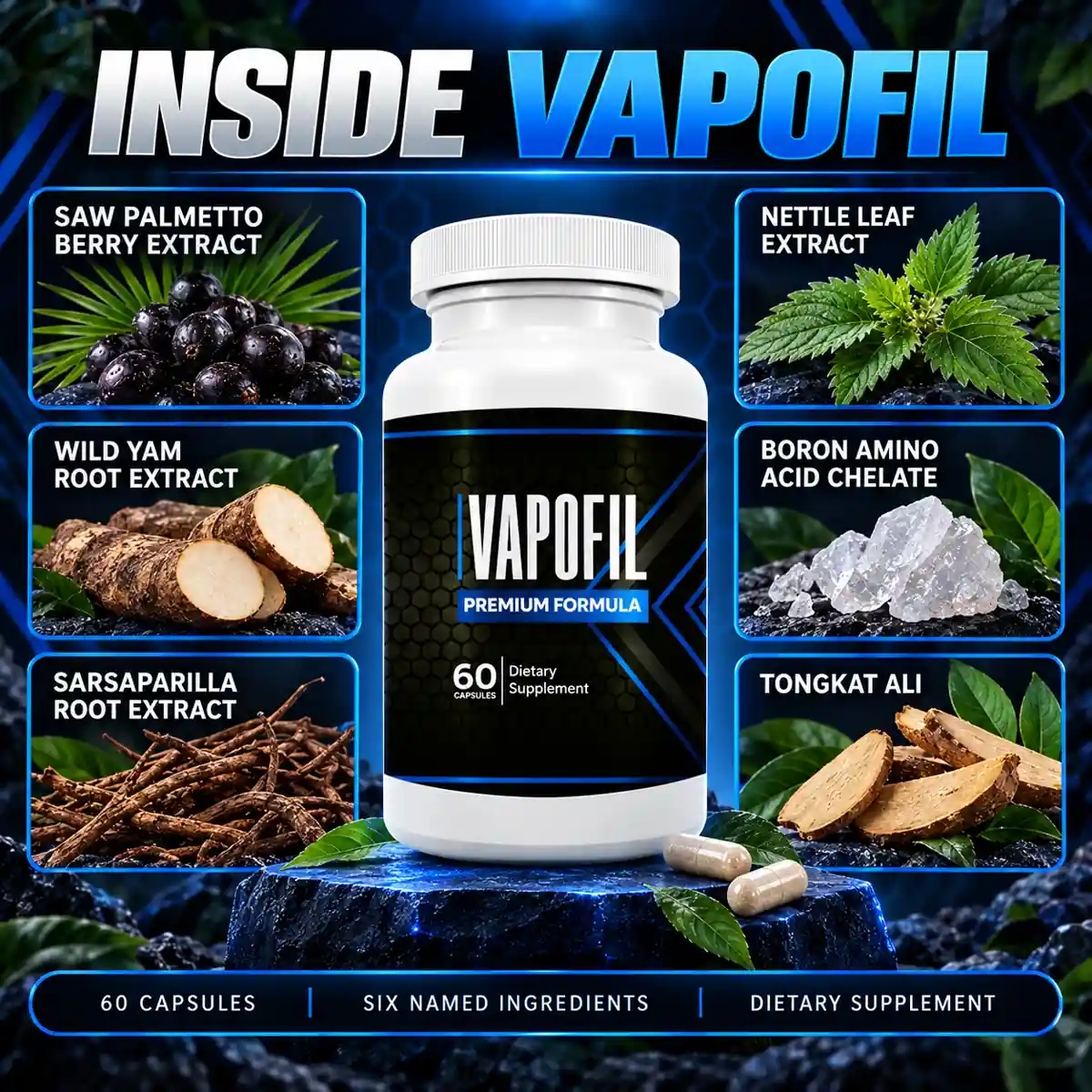
VapoFil's panel carries seven ingredients, and this website's own side-effects page already notes, in three sentences, that "several of these plants are described as hormonal in marketing copy" and that anyone with a hormone-sensitive condition should show the label to their doctor. That is sound advice as far as it goes. What it does not do is explain which ingredients carry an actual hormonal research record, in which direction, and at what dose — because that takes more than three sentences to do honestly. This article is that longer version, for three specific rows: saw palmetto, tongkat ali and boron.
These three are not chosen at random. Saw palmetto has laboratory evidence of an anti-androgenic mechanism. Tongkat ali has three human trials showing a testosterone-raising effect. Boron has one small human trial showing the same direction as tongkat ali, on a different pathway. Two rows point one way, one row points the other, and every one of them sits on this panel at a dose well below what its own trial used.
Saw palmetto: an anti-androgenic mechanism, in a dish
A 2005 study in the International Journal of Cancer found that a defined saw palmetto extract (Permixon) inhibits 5-alpha-reductase — the enzyme that converts testosterone into the more potent dihydrotestosterone (DHT) — in human prostate cancer cell lines, while leaving PSA expression unaffected. That is a genuine anti-androgenic mechanism: less DHT produced from the same testosterone, at least in a dish. It is the pharmacological reason saw palmetto is grouped with prescription 5-alpha-reductase inhibitors in urology literature, even though it is available without a prescription.
Crucially, this is cell-line evidence, not a human dose-response study, and the concentration used was chosen by researchers for a laboratory assay, not calibrated to any capsule. VapoFil's row is 20 mg of an extract with no stated ratio or standardisation, which is a separate reason the mechanism above cannot be assumed to operate at this dose — a point covered in more depth elsewhere on this journal. What matters for this article is narrower: the mechanism exists, it is anti-androgenic in direction, and no clinical trial has measured its hormonal effect in a healthy man taking 20 mg a day.
Tongkat ali: testosterone up, in three human trials
Tongkat ali (Eurycoma longifolia) runs the opposite direction, and unlike saw palmetto's mechanism story, its evidence comes from actual human trials. A 2021 randomised, placebo-controlled trial gave ageing men a standardised aqueous root extract and found a significant rise in serum testosterone over 12 weeks. A separate 2021 trial, running 6 months and pairing the extract with resistance training, found increases in both testosterone and erectile function scores in men with age-related androgen deficiency. A 2022 systematic review and meta-analysis pooling multiple such trials concluded that Eurycoma longifolia does measurably raise total testosterone in men, as a class finding across the pooled studies.
The doses in these trials ran from roughly 200 mg to 400 mg a day of standardised extract. VapoFil's tongkat ali row is 10 mg of a 100:1 extract, a fraction of the trial range even after accounting for the higher concentration ratio — the gap this panel's ratio math opens up is covered in the companion piece on 100:1 extracts. The direction of the trial evidence, though, is not in doubt: at trial doses, tongkat ali raises testosterone.
Every printed row, set beside its own research
Two capsules a day, 60 capsules to a bottle, and no row's amount hidden behind a proprietary blend.
One bottle $89 · six bottles $294 · 60-day money-back guarantee
Order VapoFilBoron: a small trial, a fast result, an unanswered question
The third row is the one least discussed anywhere on this website: boron amino acid chelate. A small 2011 study in the Journal of Trace Element Research in Medicine and Biology gave eight healthy male volunteers 10 mg of elemental boron a day and measured plasma steroid hormones before and after. After one week, mean plasma free testosterone increased and mean plasma estradiol decreased, alongside a rise in dihydrotestosterone. The authors described it as the first human study to report a rise in free testosterone following boron consumption — a real finding, from a genuinely small trial (eight men, one week, no placebo arm reported at the same visit), which is worth stating plainly rather than inflating.
VapoFil's boron row is printed as 20 mg of a chelate declared at 5%, which this panel's own arithmetic — worked through in full elsewhere on this journal — works out to roughly 1 mg of elemental boron. That is about a tenth of the dose the 2011 trial used to find its effect. Whatever that trial measured, it was not measuring 1 mg.
The three rows, side by side
| Ingredient | Direction found | Trial dose | VapoFil dose | Evidence type |
|---|---|---|---|---|
| Saw palmetto | Anti-androgenic (less DHT) | Lab concentration, not a human dose | 20 mg, no stated ratio | Cell-line study |
| Tongkat ali | Pro-androgenic (more testosterone) | ~200-400 mg/day | 10 mg (100:1 extract) | Three human RCTs |
| Boron chelate | Pro-androgenic (more free testosterone) | 10 mg elemental boron/day | ~1 mg elemental boron | One small human trial |
Two rows push the same direction as each other and the third pushes against them, at doses that are all well below what any of the three trials actually used.
What has never been tested: the combination itself
None of the three studies above tested VapoFil, or any product combining these three ingredients at these three doses. Each study tested one ingredient, alone, usually at several times VapoFil's amount. That means two things at once, and both are true simultaneously. First, the doses here are low enough relative to the trials that a dramatic hormonal swing in either direction is not what the evidence would predict. Second, "low doses of ingredients that individually point in different directions" is a different, and untested, question from "one ingredient at a known dose," and nobody has run the trial that would answer it.
This is not a reason to assume danger. It is a reason not to assume safety on the strength of a mechanism the actual research never combined. A capsule is not a spreadsheet where opposing arrows cancel out; hormone physiology has feedback loops, and the honest position is that the net effect of this specific combination, at these specific doses, has not been measured by anyone.
It is also worth being precise about why "opposing directions" is not the same as "cancelling out," because that arithmetic-sounding shortcut is exactly the kind of reasoning this panel's other label-math articles warn against. Saw palmetto's proposed mechanism acts on an enzyme, 5-alpha-reductase, that converts testosterone into DHT locally, inside tissue such as the prostate. Tongkat ali's trials measured a rise in circulating serum testosterone, a different compartment entirely. Boron's trial measured free testosterone and estradiol in plasma, by a third route that the researchers themselves said needed replication before anyone treated it as settled. Three different hormones, three different tissue compartments, three different measurement methods, in three different papers that never enrolled the same participants. Averaging their directions into a single "net effect" is not a calculation the underlying data supports; it is a guess dressed up as one.
Who this is actually worth raising with a clinician
The label's own caution, quoted in full on the side-effects page, already says to consult a physician before use if you have a known medical condition. Given the mechanisms above, three groups of readers have a more specific reason to have that conversation rather than skip it:
- Anyone being treated for a hormone-sensitive cancer (prostate cancer in particular, given saw palmetto's documented interaction with the same androgen pathway that treatment often targets).
- Anyone on testosterone replacement therapy or an anti-androgen medication, where an added ingredient pushing in either direction complicates a treatment plan a doctor is actively managing.
- Anyone with a personal or family history of hormone-sensitive conditions who has been specifically advised to avoid hormonally active supplements, even at modest doses.
For most other readers, the doses here sit far enough below the trial doses that the practical hormonal effect of a single VapoFil serving is likely to be small. "Likely small" is not the same claim as "measured to be zero," and the difference between those two statements is exactly what this article is for.
There is also a simpler, less dramatic group worth naming: anyone already taking a separate testosterone-support supplement alongside VapoFil. Stacking two products in the same broad category multiplies exposure to overlapping mechanisms without multiplying the evidence behind either one. Nobody has measured VapoFil alone at trial-relevant doses, let alone VapoFil on top of a second product making similar claims. The side-effects page's warning about stacking supplements in the same category applies here specifically, not just as a general caution.
- Saw palmetto shows an anti-androgenic mechanism in a 2005 cell-line study, not a human dose-response trial.
- Tongkat ali raised testosterone in three human trials, at 200-400 mg/day — VapoFil carries 10 mg.
- Boron raised free testosterone in one small 2011 trial at 10 mg elemental boron — VapoFil supplies about 1 mg.
- No study has tested these three ingredients together, at any dose, let alone at VapoFil's doses.
- Hormone-sensitive readers have a specific reason to raise this panel with a clinician, not a generic one.
Bottom line
This panel is not hormonally inert on paper, and it is not hormonally dramatic either. It carries one ingredient with a laboratory anti-androgenic mechanism and two with human trial evidence of a testosterone-raising effect, all three well below the doses their own research used, and none of them tested together. That combination of facts supports a specific, narrow piece of advice: readers with an existing hormone-sensitive condition or treatment plan should read the label to their prescriber rather than reason from a marketing page, this one included.
References
- Habib FK, Ross M, Ho CK, Lyons V, Chapman K. Serenoa repens (Permixon) inhibits the 5alpha-reductase activity of human prostate cancer cell lines without interfering with PSA expression. Int J Cancer. 2005;114(2):190-194. PMID 15543614. https://pubmed.ncbi.nlm.nih.gov/15543614/
- Leisegang K, Finelli R, Sikka SC, Panner Selvam MK. Eurycoma longifolia (Jack) Improves Serum Total Testosterone in Men: A Systematic Review and Meta-Analysis of Clinical Trials. Medicina (Kaunas). 2022;58(8):1047. PMID 36013514. https://pubmed.ncbi.nlm.nih.gov/36013514/
- Chinnappan SM, George A, Pandey P, et al. Effect of Eurycoma longifolia standardised aqueous root extract-Physta on testosterone levels and quality of life in ageing male subjects: a randomised, double-blind, placebo-controlled multicentre study. Food Nutr Res. 2021;65:5647. PMID 34262417. https://pubmed.ncbi.nlm.nih.gov/34262417/
- Leitão AE, Vieira MCS, Pelegrini A, et al. A 6-month, double-blind, placebo-controlled, randomized trial to evaluate the effect of Eurycoma longifolia (Tongkat Ali) and concurrent training on erectile function and testosterone levels in androgen deficiency of aging males (ADAM). Maturitas. 2021;145:78-85. PMID 33541567. https://pubmed.ncbi.nlm.nih.gov/33541567/
- Naghii MR, Mofid M, Asgari AR, Hedayati M, Daneshpour MS. Comparative effects of daily and weekly boron supplementation on plasma steroid hormones and proinflammatory cytokines. J Trace Elem Med Biol. 2011;25(1):54-58. PMID 21129941. https://pubmed.ncbi.nlm.nih.gov/21129941/